




Fresh concrete wastewater sitting at a pH between 11 and 13 is caustic enough to cause chemical burns to aquatic organisms on contact. Sediment-laden surface water from earthmoving carries fine particles that settle in drainage infrastructure and smother waterway beds over months and years. Both of these outcomes happen regularly on Australian construction sites, and both are preventable. As regulators in Western Australia and across the country tighten enforcement of stormwater pollution controls, the question of how slurry-laden water is managed on site has shifted from a best-practice recommendation to a compliance requirement with real financial consequences attached.
What a Dewatering Filter Bag Actually Does?
A dewatering filter bag refers to a permeable geotextile bag that holds suspended solids inside itself while allowing water to pass through the weave of the fabric using hydraulic pressure. The slurry-filled water enters the bag filter for water treatment via a discharge hose attached to site pumps or slurry equipment. Water passes through the weave of the fabric, suspended particles remain in the bag, and the accumulated mass is then removed independently of the filtered water.
Filtering occurs according to the following parameters: fabric weight and weave, both of which are described in grams per square meter of fabric. Heavier non-woven geotextile is capable of holding finer particles but drains more slowly. On the other hand, lighter fabric drains faster but allows for the passing of smaller particles through it. The appropriate specification is based on the particle size distribution in the wastewater, which can be completely different for such types of waste as concrete saw slurry, earthmoving sediment runoff, and diamond core drilling waste. A felt-lined bag will add another filtering layer appropriate for fine particle streams. A standard bag applied to fine concrete slurry will produce a filtrate that will still be turbid and won’t satisfy compliance standards.
Where Filter Bags Fit in a Complete Site Water Management System?
Using a dewatering filter bag in isolation solves one of the stages of a comprehensive problem. Sites that apply filter bags without dealing with upstream generation of slurry keep producing amounts of wastewater that put pressure on bag capacity, leading to the frequent changing of the bags, placing them improperly due to time limitations, or bypassing them altogether due to tight deadlines.
Flocculants used in combination with dewatering bags alter the upstream process in practice and in a meaningful way. The application of flocculants causes fine suspended particles to join together into bigger masses prior to entering the filter bag. As a result, fabric retains bigger masses of particles, filtrate becomes clearer, and the life of the bag is extended according to the volume of water passed. Solidification agents turn the liquid slurry into a semi-solid state at the stage of generation, thus minimising the amount of liquid that needs to be processed further. These products complement rather than substitute dewatering bags, and sites applying them together solve the problem of wastewater management in a more efficient manner.
The Regulatory Context in Western Australia
The Stormwater Management Manual of Western Australia, which is produced by the Western Australia Government, categorises stormwater as a resource that carries active environmental responsibilities for its producers and managers. Construction sites are listed as one of the main sources of stormwater pollution. State Planning Policy 2.9 of Water determines how water should be handled through the development process, and construction is included as a clear part of it.
Perth City Council and other councils in Western Australia have become more systematic in their efforts to identify active construction sites through their inspection programs, especially during and following rainfall. Sites that are caught discharging any sediment or concrete wastewater into stormwater collection facilities are exposed to penalties according to both state environmental legislation and local by-laws. Inspection programs across Australia have shown repeatedly that the knowledge of regulatory requirements becomes higher on construction sites after active inspections; such an assumption about Perth sites is well justified.
Why Buying the Cheapest Bag Consistently Costs More?
Load capacity is the key element that distinguishes a functioning dewatering bag from one that breaks down in the field. When you buy a 1,000-kilogram bag, it gives you some safety margin in the case of faster slurry accumulation than filtration. The bag that breaks under the load discharges all of its accumulated material as a concentrated mass, which creates more serious problems than slow filtration would have, and produces a new task of cleaning up this material at the site.
Construction of seams and handles determines whether the bag will survive when it is picked up for dumping. Seams breaking during moving is the most frequently cited failure cause for lower-cost bags; if the seam breaks, the material inside the bag will be dumped at the site instead of going to the dumpster. Material tearing where the hose is connected to the bag opening is another frequent cause of failure for bags not designed to take the pump’s discharge pressure constantly. This problem can easily be avoided if you choose a bag made to your needs.
Disposing of the Retained Solids: The Step That Catches Sites Out
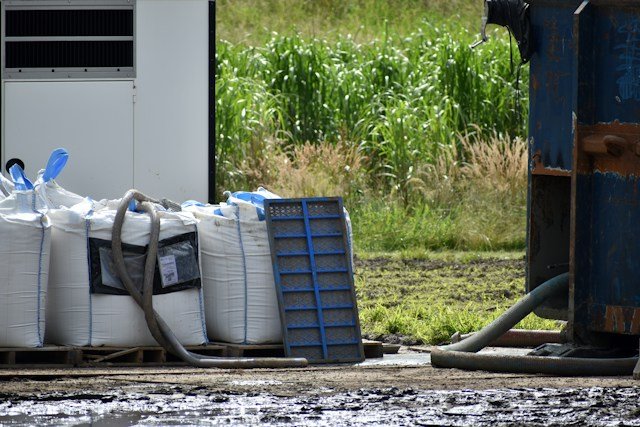
The filtered water is just half of the results achieved. The solids collected in the bag need proper disposal, a process which is often improvised when the bag is full and there is no solution in sight. Concrete slurry is non-hazardous construction waste in almost all scenarios but cannot be deposited in regular skip bins unless verified by the waste management company that they accept the material. Dry concrete slurry waste is allowed in licensed construction and demolition waste sites, but checking out the acceptable waste types beforehand helps avoid this problem.
Wet concrete slurry still poses a danger due to its caustic nature before curing is completed. Disposal of such material without any personal protective clothing is not safe; the neat appearance of a full bag might actually conceal the danger.