



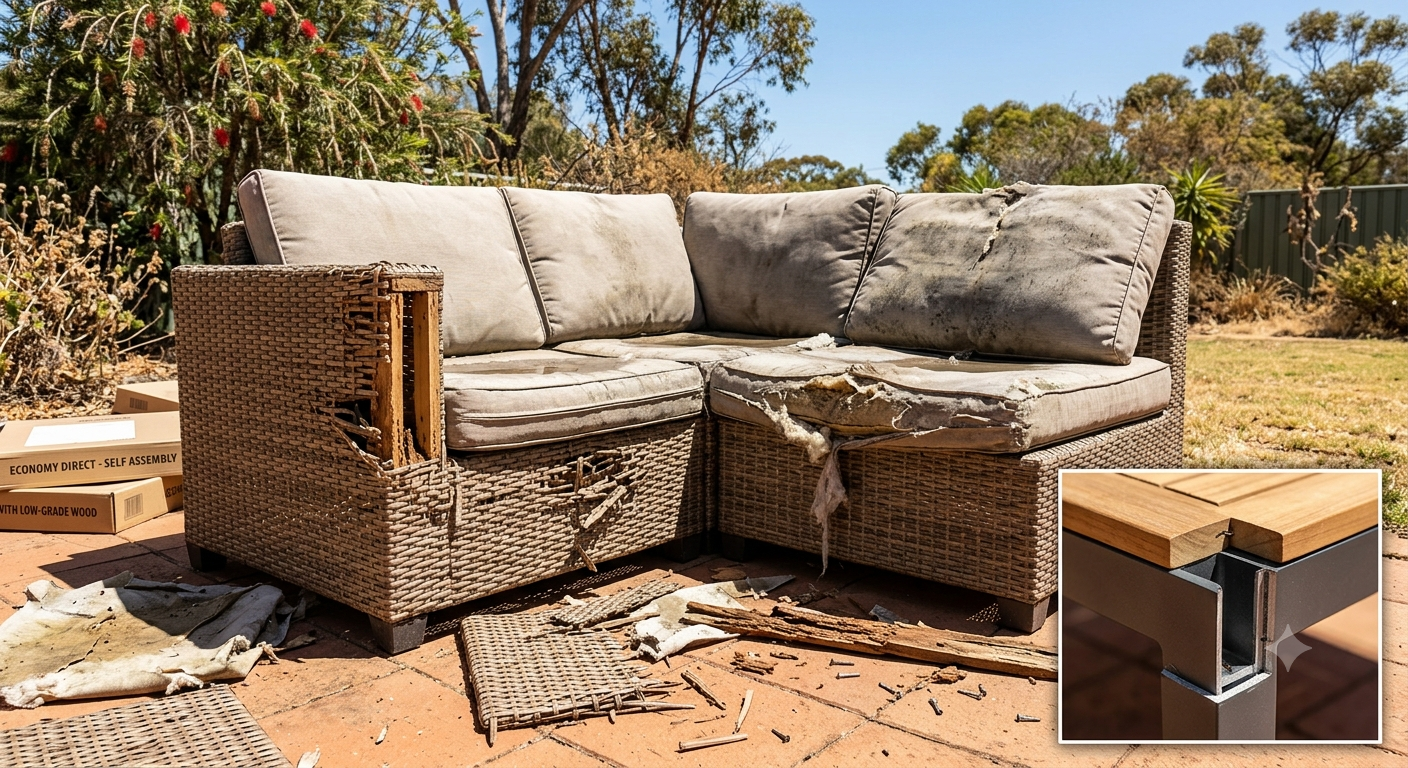
Australians are the ultimate outdoor enthusiasts. We spend more time basking in the sun than almost anyone else on the planet. Ask anyone who’s made the mistake of buying outdoor furniture, and they’ll tell you the same sorry tale. Two summers in, and it’s all gone to pot. At the heart of the problem is the outdoor corner lounge, the supposedly stylish centrepiece of our alfresco zones that so often ends up being a pricey lemon. It starts way before you even think about clicking the “buy now” button.
Why the Corner Format Took Over Australian Backyards?
The L-shaped lounge didn’t become our go-to furniture style because of some marketing guru’s clever idea. It’s because it actually works for the way we use our outdoor spaces. We love gathering with mates and family, setting up our seating to face the action, whether that’s a fire pit, a big screen, or just the stunning view. Our outdoor areas are also getting smaller and smaller. The corner lounge is the perfect solution. It creates a snug little social zone that’s perfect for settling in with a cold one on a Saturday arvo. It does all that without the need for a solid wall to prop it up. Let’s be honest, a row of chairs just doesn’t have the same vibe as a comfy corner lounge, does it? It’s also one of the most practical options out there, especially if you’ve got a tiny courtyard to work with. That’s why it’s become the default choice for new builds and renovated homes.
The Material Question Nobody Answers Properly
We’ve all seen the claims. Powder-coated aluminium, synthetic rattan, or PE wicker, teak, and stainless steel are all presented as top-notch options. The truth is they perform pretty differently in our Aussie climate. Up on the coast, the humidity can turn certain finishes to mush in no time. If you’re in the hot, dry centre of the country, some synthetic weaves can warp and distort before you know it. Don’t even get me started on the cushions, UV-stable fabrics, quick-dry foams, and all that jazz. If you want one that’ll last the distance, it’s worth asking a few questions.
PE Rattan vs Teak: What the Price Reflects
If you’re in the market for something in the $800 to $3,500 range, PE rattan is probably your best bet. Here’s the thing, though, you get what you pay for. Cheap PE rattan uses thin strands that will start to crack and fade after a couple of summers. Premium PE rattan is made with thicker, more robust strands that are coloured all the way through. That’s the stuff that’ll last. The trouble is that distinction isn’t always easy to spot from a product photo. Ask yourself this question. Does the colour go all the way through the strand, or is it just sitting on the surface? That’s where the real differences start to show.
Modular vs Fixed: The Decision That Locks You In
Fixed corner lounges offer a level of rigidity. Modular systems now dominate the Australian market because they let people buy something compact and then expand it as their household grows. That’s a financially sensible approach. Of course, it’s not without its downsides. A genuine modular system will use section connectors that line up perfectly and stay in place while you’re using them. Cheaper options sold as modular are often just loose sectionals. They will start to come apart and leave gaps over time. The problem is that the distinction isn’t always clear in the product listing. It’s only when you’re trying to move things around after a dinner party and find bits that won’t stay in place that you work out the difference.
What Modular Gets Wrong at the Budget End?
At sub-$1,000 price points, the modular promise just doesn’t deliver. The frames are thinner, the welding is hit and miss, and the cushion foam is non-draining. That means it absorbs moisture and starts to get mouldy by the first winter. Modular designs require super precise tolerances between the sections. At lower manufacturing budgets, those tolerances get away from you. Before you know it, the thing looks great in the showroom but is a nightmare to use in real life.
What the Price Range Actually Reflects?
The Australian market runs the gamut from around $400 for a flat-pack import to $9,000 and upwards for a teak and Sunbrella setup. At the entry end, the frames are thinner, the welding is inconsistent, and the cushions are filled with foam that just holds moisture. Research shows over and over that generic outdoor furniture designed for European or American conditions usually fails within two or three years under the intense Aussie sun. Australia’s UV levels are around 40% higher than European standards. The middle ground of $1,500 to $3,500 is where most buyers should focus. It’s especially worthwhile if you’re looking for brands that do some Australia-specific testing and offer a decent warranty. Anything over $4,000 is mainly for the prestige of teak or designer branding. It doesn’t necessarily bring a significant upgrade in everyday durability.
Coastal vs Inland: Why Location Changes Everything
A corner lounge that does great in Melbourne’s beachside suburbs is going to fall apart a lot faster in Cairns. Salt air can corrode the powder coating on anything that isn’t marine grade. Up in Queensland, the sun is an entirely different beast compared to Tasmania. That’s not a small difference. People make this mistake all the time when buying outdoor furniture. They fail to account for their climate zone. The retail industry doesn’t usually address this directly because it complicates the sales pitch. If you’re near the coast, you need marine-grade aluminium with decent powder coating. In a humid climate, you need quick-drying foam with some kind of anti-microbial treatment. Those aren’t luxury add-ons. In the right conditions, they’re the bare minimum you need if you want your furniture to last more than a couple of summers.